All Blogs

>>

Blog

4 diseases in dogs and cats that come with the rain. Know how to prevent them beforehand!
2022-08-30 | 10 Mins read


Achoo!! During the rainy season, the most common diseases that we often encounter or are typical to those around us can be some common cold, influenza, dengue fever, or conjunctivitis. For those who have to be soaked in water for a long period of time, they may encounter skin diseases such as foot ulcers. Some diseases can be prevented by vaccination, exercise, consuming nutritious food, maintaining cleanliness of the body, and getting enough sleep. In fact, pets, like dogs and cats, can catch diseases that owners should be aware of during the rainy season as well, including ways to prevent it. Today, we have gathered useful information for owners to be cautious about.


Heartworm Disease

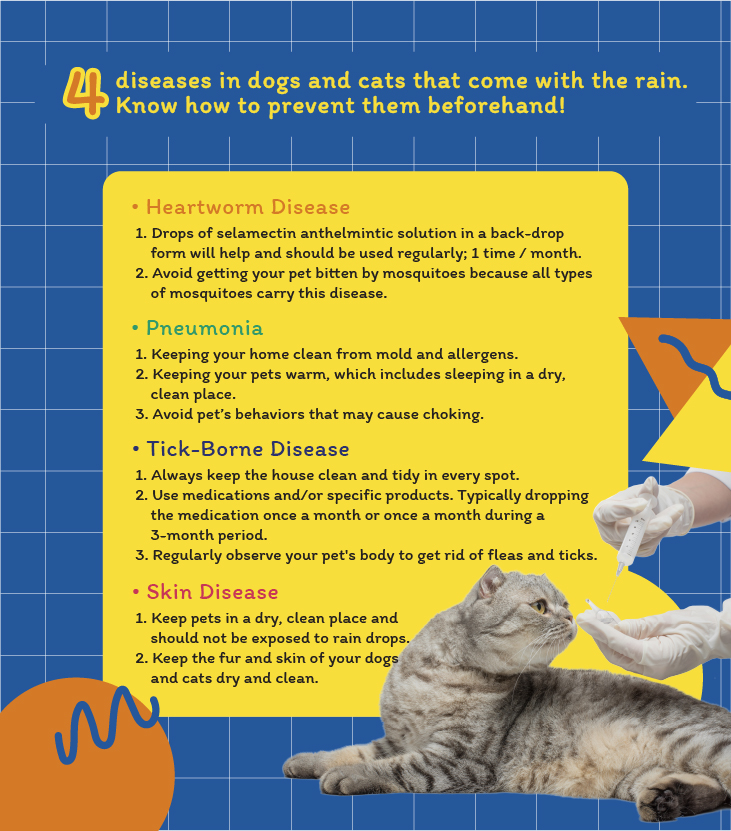
Symptoms

Symptoms can range from mild ones, such as losing appetite, coughing, sneezing, and symptoms that may resemble colds and anemia, to more severe symptoms such as pneumonia, difficulty breathing, liver and kidney failure, or even death.

Ways to prevent the disease

1. Drops of Selamectin anthelmintic solution in a back-drop form will help and should be used regularly; 1 time per month.

2. Avoid getting your pet bitten by mosquitoes because all types of mosquitoes carry this disease.


Pneumonia

Symptoms

Pneumonia can be caused by pets choking, inhaling mold, or allergens into the body. Pets will have high fever, runny nose, cough, have much gum (in the eyes), lethargy, loss of appetite, watery eyes, and difficulty breathing. Some may even be breathless. For this disease, if the pet's immunity is not strong enough, symptoms can get worse, which may unfortunately cause death.

Ways to prevent the disease

1. Keeping your home clean from mold and allergens.

2. Keeping your pets warm, which includes sleeping in a dry, clean place.

3. Avoid pets that may cause choking.


Tick-Borne Disease

Symptoms

Symptoms include drowsiness, loss of appetite, fever, anemia, and owners may notice the color of their gums or conjunctiva. In some cases, vomiting and diarrhea may occur. However, symptoms depend on the stage at which the disease is at. The severity of the disease and symptoms observed may vary.

Ways to prevent the disease

1. Always keep the house clean and tidy in every spot, in order to prevent ticks and fleas from fertilizing or laying eggs, especially during the rainy season.

2. Use medications and/or specific products that are used to get rid of fleas and ticks. Such as back-drops or oral medication for dogs and cats. Typically dropping the medication once a month or once a month during a 3-month period.

3. Regularly observe your pet's body to get rid of fleas and ticks.


  Skin Disease

Symptoms

Pets may feel itchy and frequently scratch their skin. They may show signs of severe scratching, rashes, dry, red skin, flaking, scabs, patches of hair loss, or hair loss over the body in large areas. In addition, if the irritation is severe, there may also be signs of wounds.

Ways to prevent the disease

1. Keep pets in a dry, clean place and should not be exposed to rain drops.

2. Keep the fur and skin of your dogs and cats dry and clean.


Although some diseases may not show immediate symptoms, the incubation period may take weeks, months, or even longer. Pets may get various germs during the rainy season. Therefore, taking care of their health on a regular basis will help them positively in the long run. However, when pets start to get sick, whether the symptoms are mild or severe, they should be immediately taken to the veterinarian for a diagnosis to treat the disease quickly and in a timely manner.


Source:

https://thonglorpet.com/th/diary/รู้ก่อน-เตรียมรับมือก่อน-กับการดูแลสุนัขในหน้าฝน

https://www.punpro.com/p/5-serious-pet-diseases-in-rainy-season

https://masii.co.th/blog/โรคร้ายในสุนัข-หน้าฝน

7 tricks in adjusting your dog’s behavior to being potty trained!

  Have you ever just chill, relax, but suddenly smell a weird odor, causing you to block your nostrils from your dog not defecating in the right place? Whether it's the floor, in the corner of the room, the rug, the legs of the table, the curtains, the bed, or our favorite set of sofas. Anyone who encounters this problem will definitely have a headache because in addition to the damage that has occurred, it’s followed by the issue of cleaning, which is quite difficult. Plus, the unpleasant smell as well. Many people may wonder, why is their dog not defecating in the right place? How do we fix this problem? This article has compiled solutions for you.     Why is my dog unable to defecate in the right place? Reasons that your dogs are not defecating in the right places may be caused by different factors such as:   ●  The dog may be too young or too old. It may be difficult for them to adjust at first. ●  Not yet familiar with the place provided for excretion. ●  Caused by underlying health problems. ●  Not eating and excreting on time. ●  Have stress or anxiety. ●  Other factors involved, which may differ for each dog or breed.   7 tricks to adjust their behavior and training dogs to excrete in the right places 1. Allow them to get used to the time and place for excretion Dogs should be trained to excrete at intervals. When it's time, take the dog to the excretion spot immediately. This will help your dog adjust to the behavior of excretion naturally.   2. Use the same command words repeatedly or often When it's time to excrete, try using the same words or phrases with them. This will allow the dog to be familiar and adapt to a behavior, such as ‘come poop’, ‘come pee’, ‘go to the toilet’, ‘pee here’, etc.   3. Schedule a meal time To prevent your dog from eating and excreting all day; if your dog can’t finish their meal in time, collect or empty their food within half an hour. Don't leave it out.   4. Use the same smell or marks to practice their excretion The same smell or marks that your dog excrete can be used to train them to excrete in the right spot.   5. Immediately give an order if the dog excretes outside the designated spot Give commands like ‘No’, which are specific words that deny the dog to excrete outside the spot, with a serious tone and demeanor.   6. Do not punish or scold angrily In training, you should gradually train them, don’t use emotions, don’t punish them with violence, and don't scold the dog angrily.   7. Take him to see a veterinarian or specialist Try consulting a veterinarian or a specialist to find the right way in training your dog.   Studying and understanding your dog’s behavior, habits, and their breed will help us understand them more. Potty training is another matter that we need to focus on because the habit of excretion helps them to have a good excretory behavior and owners, like us, are allowed to feel relieved, we can breathe through our lungs freely because the house is clean, there is no unpleasant smell from excretion. When the dog obeys orders or begins to behave in a better way, we should complement and give them treats or other rewards that your dog favors. This will help the dog learn and understand what we want to communicate faster.   Source https://www.jojohouse.com/ฝึกน้องหมาฉี่เป็นที่/ https://pet.kapook.com/view204786.html https://www.yespetshop.com/th/articles/97510 https://thonglorpet.com/th/diary/การแก้ไขการขับถ่ายไม่เป็นที่

Are clothes necessary for dogs and cats? Which breeds are required to wear them?

  When entering winter, we will see a variety of winter fashion out there, a variety of eye-catching colors, which is no different with pet’s fashion clothes that are equally bold. Seeing the choices of clothes picked for them is like bringing a small fashion week to the house. In addition, we are united in showing off their cuteness and adorableness, often seen on social media, but in fact, has anyone ever wondered how necessary those clothes are? Do dogs and cats really need to wear coats in winter? Let's find out.     ● Are clothes necessary for dogs and cats? The necessity of clothes for dogs and cats may not be clearly measured because there are many factors involved, such as the length and thickness of their hair according to their breed, the environment of the house, and the overall habitat. If you are in Thailand, there may not be as much winter or the temperature may not be as low as living in a country with a cold climate, however, it would be better to observe if your pet has a cold or not.   Do: If your pet has symptoms such as curling up, tremors, and pale gums, they may have a cold. Clothes should be worn for them by choosing the right amount of thickness on the fabric, according to the hair length of their breed. Don’t: If your pets show resistance in wearing clothes, you shouldn't force them because there may be some undesirable behaviors that follow through. For example, stress, fear, and frustration, which can have negative effects.   ● Which breeds need clothes during the winter? Dogs: Such as Greyhound, Dalmatian, French Bulldog, Chinese Crested, Pug, Chihuahua, Dachshund, Miniature Pinscher, and Jack Russell Terrier Cats: Such as Sphynx, Devon Rex, Siamese Cat, Abyssinian cat, and Bambino   In addition to letting pets wear clothes during the cold weather, we may look for other suitable ways to help relieve the cold for dogs and cats, such as allowing them to sleep on a warm bed and avoid taking them outside. For those who raise pets in a semi-open or semi-closed manner, during cold weather, limit the amount of time your pet is outdoors. Including the temperature in the house that can be adjusted to an appropriate temperature, this will help them get warmer and relieve coldness.   Sources https://www.central.co.th/e-shopping/true-or-fake-dog-and-cat-should-wear-cloth-in-cold-season https://www.petsbest.com/blog/dogs-wear-coats/ https://www.pawtracks.com/cats/cat-clothes-cold-weather/