Is insect-based food for pets truly sustainable?

Even though some scientists have been concerned about the scale of farming of insects, they are a new trend in sustainable foods for people and also for animals. This is because conventional animal foods are made from grain, which requires a huge area for farming and manufacturing which is not good for the environment due to forest destruction.
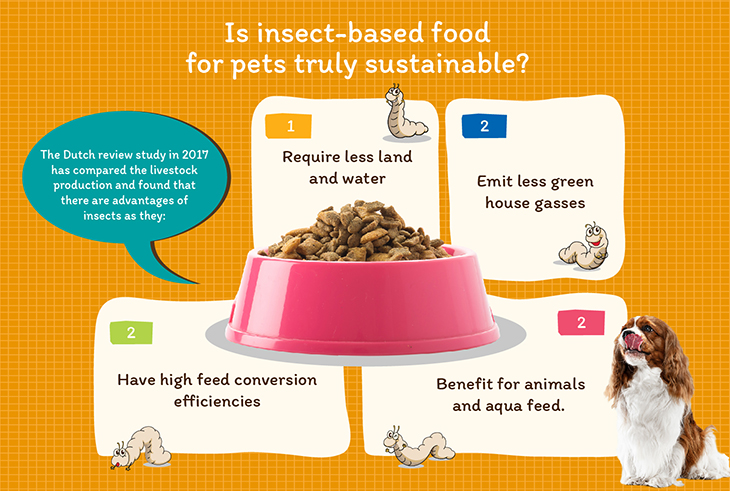
The Dutch review study in 2017 has compared livestock production and found that there are advantages of insects as they:
- Require less land and water
- Emit-less greenhouse gases
- Have high feed conversion efficiencies
- Benefits for animals and aqua feed.
In 2020, the researchers in U.K. and Germany have concluded that the impact of pet food “are equivalent to an environmental footprint of around twice the U.K. land area, and would make greenhouse gas emission from pet food around the 60th highest emitting country, or equivalent to total emissions from countries such as Mozambique or the Philippines.”
Bugs are less than appetizing to many people, but getting pets to feast on insects might be a walk in the park. According to the American Pet Products Association, start-ups and long-established companies are introducing bugs to change the pet food market. In 2020, this worth about $42 billion in the U.S.
In 2019, Yora Pet Food, the British start-up, introduced the first insect protein pet food and sold it in the U.K by targeting customers who are environmentally conscious pet owners. It expects to have shipped the product of over 200 tons and generate sales of over $2.8 million. Such a business is part of a movement around the world as manufacturers in North America, Europe, and beyond are trying to make pet food more sustainable and environmentally friendly by using proteins from insects instead of animals.
Nestlé introduced a Purina pet food containing fly larvae, plant, and animal protein last November. Purina Beyond Nature’s Protein for dogs and cats has been launched in Switzerland. Nestlé carefully balanced the contribution of the different protein sources, including insects, in cat and dog recipes to fulfill animals’ specific nutritional needs.
In 2030, the demand for insect protein to be used in pet food and animal feed could hit half a million metric tons compared to about 10,000 metric tons currently. According to the report in 2021 by RaboResearch, the insect industry is increasing in scale and backed by investments and partnerships, while the cost can decrease with the increase in technology, automation, improvements in genetics, and legislative changes.
The animal foods from insects will help your pets healthier because it is similar to their natural food source more than grain. Moreover, it is also sustainable and worth producing.
Source : https://www.cnbc.com/2021/06/12/more-pets-eating-insect-food-to-fight-climate-change-for-owners.html
https://missiontothemoon.co/society-edible-insects/